Ways to Differentiate Real and Fake Honey in Malaysia
Table of Contents
Approximately 16 years ago, a teacher discovered cave paintings dating back to around 6000 BCE in the Alaniya Cave in the Valencia region of Spain. In addition to depicting animals such as deer and wild boar, the paintings also portrayed scenes of honey collection, marking the earliest known human interaction with bees.
According to research, beekeeping-like activities began around 5000 BCE. Before humans discovered sugarcane, honey was considered the only sweetener. Many people are aware of the benefits of honey, but when there’s a wide array of honey products, they may wonder if the honey they buy is truly pure or if it has been adulterated with other syrups.
Background
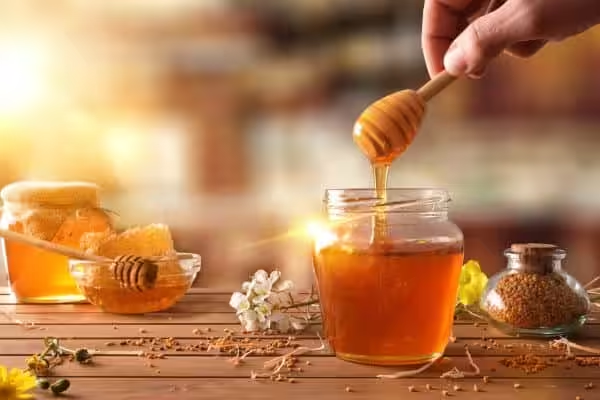
In November 2017, the Malaysian Ministry of Agriculture released a jaw dropping data, whereby 80% of the honey in the Malaysian market is not pure. The Ministry of Health collected 77 honey samples from the market and found that 7 of them contained no honey at all, only 10% were pure honey, and a staggering 80% of them were synthetic honey. These synthetic products are made with ingredients such as sugar, vinegar, lime powder, and flavorings, or they are mixed with a small amount of real honey. Prolonged consumption of such products can increase the risk of cancer and diabetes, earning them the nickname “diabetes honey.”
As one of the fastest-growing food products in the world, honey production continues to increase globally. This has led to a reduction in the natural habitats of bees, as forests and wooded areas diminish. The beekeeping or synthesis of honey has become a growing trend due to the decreasing availability of natural bee habitats.
According to research, beekeeping-like activities began around 5000 BCE. Before humans discovered sugarcane, honey was considered the only sweetener. Many people are aware of the benefits of honey, but when there’s a wide array of honey products, they may wonder if the honey they buy is truly pure or if it has been adulterated with other syrups.
7 types of honey in the Malaysian market:
1. Raw Honey
Bees store nectar with approximately 80% moisture content in their bodies, which is then processed into honey through enzymatic action. The bees then fan their wings continuously to reduce the moisture content to less than 20%. The honey is sealed with beeswax after maturing. Raw honey is highly nutritious.
2. Unripe Honey
Honey that has not matured (the comb is not sealed) has a lot of bubbles and may produce a popping sound when opened. It has lower nutritional value and carries a risk of bacterial contamination.
3. Cold-pressed Honey
Honey that is not fully mature and has been extracted at temperatures below 60 degrees Celsius. Its nutritional value is lower, and it is often found in imported honey.
4. High-Temperature extracted Honey
Honey is not fully mature and has been processed at temperatures exceeding 60 degrees Celsius, resulting in high concentration and even a paste-like texture.
5. Fake Honey
Made with ingredients such as fructose, maltose, flavorings, vinegar, and lime powder (Calcium Oxide), fake honey does not contain any honey at all and is more like syrup.
6. Feeding Honey
Produced by feeding bees with syrup when there are no flowers nearby, resulting in honey with lower nutritional value.
7. Blended Honey
A combination of the above materials, some of which may contain real honey components, while others may have none at all.
In summary, the purest and healthiest honey is one that is unprocessed, not blended, and not created by feeding bees. According to Malaysian Food Act 1983, honey can be sold as long as it meets its specifications.
When purchasing honey, many consumers tend to do a series of tests in hope that the honey they buy is authentic. However, synthetic and fake honey can actually mimic the specific physical or chemical characteristics of real honey, making it challenging to detect adulterated products.
Some pure honey may contain very fine bubbles, which are often pollen grains from the flowers. These bubbles should not be confused with the thick foam found in unripe honey.
Honey’s transparency and colour, do not necessarily relate to its authenticity. Different varieties of honey, sourced from different flowers, will have varying colours and levels of transparency. Light-coloured Malaysian honey tends to have a clear appearance, while darker honey is richer in flavour and has higher vitamin content.
Some people may also perform a series of tests such as placing honey on their nails or on a piece of paper to distinguish pure honey from fake honey. These tests can only determine the moisture content of the honey.
Identify adulterated honey through professional honey adulteration systems:
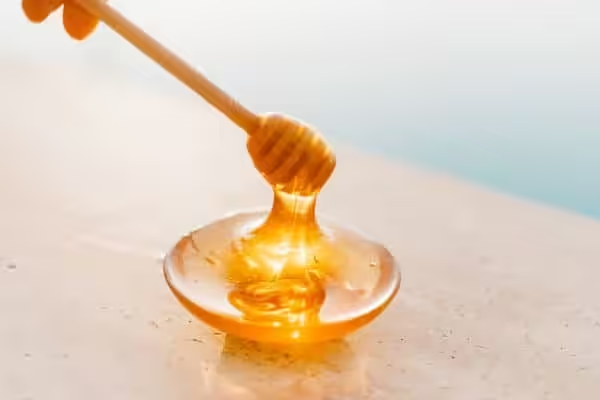
1. Analysis of Moisture Content (Pure honey should have over 18% moisture content):
If the moisture content is too low, it is likely to have undergone high-temperature treatment. If the moisture content is too high, it may be due to the addition of water or unripe honey.
2. Analysis of the Ratio of Glucose to Fructose:
In most cases, the ratio of glucose to fructose in honey is approximately 1:1, except for some honey like eucalyptus honey and longan honey, which have a ratio of 2:1. If one of these ratios is significantly higher (e.g., 4:1), it is likely to contain added artificial fructose or other ingredients. Honey extracted at high temperatures has an obvious separation of layers.
3. Verification of Raw Honey:
Finding completely unprocessed honey that has been preserved properly is rare. Generally, mature honey has low moisture content, and it can be stored without any processing. However, if honey needs to be exported to multiple countries, regulations may require honey to undergo appropriate processing to remove excess moisture.
The standard for heating is generally checked by measuring HMF (HydroxyMethylFurfuraldehyde), a special compound formed when fructose is exposed to high temperatures. In tropical countries, honey may contain higher levels of HMF. If the HMF level is too high, it means the beneficial sugar structure in honey has been altered, which is not conducive to health.
HMF standard for temperate and cold countries: Not exceeding 40mg/kg
HMF standard for tropical countries: Not exceeding 80mg/kg
(Malaysian food regulations stipulate that the monosaccharide ratio must be at least 60%, otherwise, it is defined as synthetic honey. The Ministry of Agriculture confirms synthetic honey based on HMF standards. In recent years, there have been more sellers claiming to sell real honey online, so consumers need to be cautious.)
4. Diastase Activity:
Diastase is an essential enzyme that converts starch into monosaccharides. It is generally present in bees’ saliva. Measuring the activity of enzymes like diastase is an important method to verify the authenticity of honey and detect adulteration.
5. Carbon Isotope Ratios (C3 and C4):
Authentic honey, produced by bees from nectar, will contain C3 carbon isotopes. If the C4 ratio is significantly higher, it is likely that artificial syrups have been added.
6. Pollen Type:
Real honey should contain pollen from local flowers. It can be verified by comparing the honey with local plant data. If the pollen types in honey do not match the plant types in the region, it is likely to be considered honey from another area.
Verification of Mature Honey:
Proline is one of the main amino acids in honey, making up 50-85% of the total amino acids, typically a minimum of 180mg/kg. Proline is also one of the important indicators for determining mature honey. If proline levels are too low, it may be an indication of blended or adulterated honey.
How to determine if your honey contains high antioxidant?
Honey’s antioxidant properties are primarily derived from phytonutrients, which are natural compounds found in plants. There is no standard recommended daily intake for antioxidants, so a specific definition for “high-antioxidant” honey has not been established.
Some people may believe that buying honey from orang asli ensures purity. However, this is not always the case.
Common Claims/Myths in the Market:
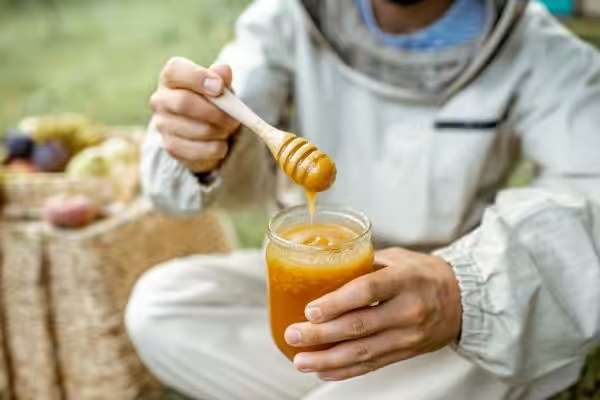
1. Buying from Indigenous People Ensures Purity:
This is not necessarily true. Due to the rapid deforestation in Malaysia, beehives are becoming increasingly scarce. It is challenging to find beehives; besides that, a single beehive can only harvest approximately 10kfg of honey. Even if they are found, they may not have matured before being harvested, leading to the possibility of blending with other substances to increase yield.
2. Honey with Ants Inside Is Fake:
Honey naturally attracts ants if it has a high moisture content. If honey is not sealed tightly and moisture enters it, ants are likely to be attracted.
3. Honey Forms a Hexagonal Hive Shape When Dripped onto a Plate:
This is a misconception. The formation of hexagonal shapes when liquid impacts a surface is a natural phenomenon, unrelated to the authenticity of honey. This can be demonstrated using dishwashing liquid as well.
4. Squeezing Honey from the Hive Confirms Purity:
Beehives and sugar syrup can be combined to create the illusion of genuine honey. However, beehives that are sealed and do not have honey soaked into them are less likely to be tampered with. It is still challenging to ensure that such honey is not feed-based.
5. Honey Must Be Consumed with an Iron Spoon:
Iron and steel spoons are generally made from low-reactivity metals, which do not react significantly with honey. Using an iron or steel spoon to consume honey is perfectly safe. However, it is not encouraged to store honey in containers made of these materials or to immerse honey in them. Taking honey with a spoon typically only takes a few seconds, and there is not enough time for a chemical reaction to occur between the metal and the honey. Hence, it is perfectly fine to consume honey with a metal spoon.
Best Way to Consume Honey:
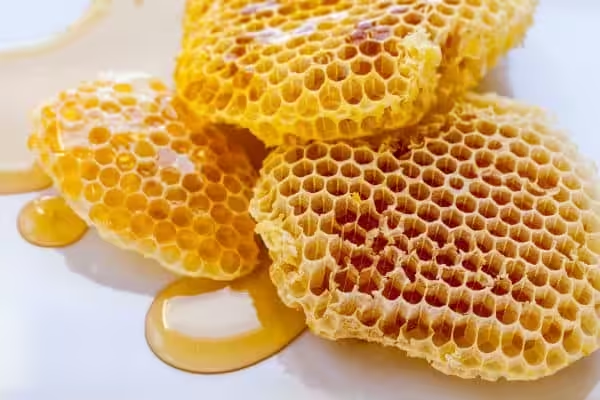
It is recommended to consume honey directly or mix it with warm water at around 40 degrees Celsius. Honey can be consumed by anyone over the age of one. In Malaysia, to ensure that you are buying genuine honey and not a blended product, you can request the manufacturer to provide a sugar content analysis report, which can be used to verify the purity of the honey.
1. The proportion of pure honey monosaccharides must exceed 60% of the total sugar content.
Examples of monosaccharides are: Glucose, Fructose, Galactose
2. Pure honey sucrose (sucrose) cannot exceed 10%. This is what we generally recognize as white sugar.
Example 1: Honey A
1. Total Sugar 10g/100g
2. Glucose 1g/100g
3. Fructose 1g/100g
4. Sucrose 7g/100g
Assessment: The ratio of simple sugars: sucrose is 2:7. This honey is likely an adulterated honey that was mixed with a large amount of white sugar.
Example 2: Honey B
1. Total Sugar 10g/100g
2. Glucose 5g/100g
3. Fructose 4g/100g
4. Sucrose 1g/100g
Assessment: Monosaccharide:sucrose ratio is: 9:1. This honey should be pure honey.
In summary, while various tests and analyses can help in verifying the authenticity of honey, consumers can rely on their senses and basic knowledge to identify pure honey. Be aware that genuine honey may vary in aroma and taste due to the different types of flowers from which it is sourced. Finally, understanding the principles of honey production and its properties can help consumers make more informed choices when purchasing honey.
Related guides
Ready for a plan built around you?
Turn general advice into a plan built for your body, your health and your goals. Every consultation is one-to-one with our registered dietitian.
Book a consultation Explore a personalised nutrition consultation